Predicting the Unpredictable | Post Shoot Learnings
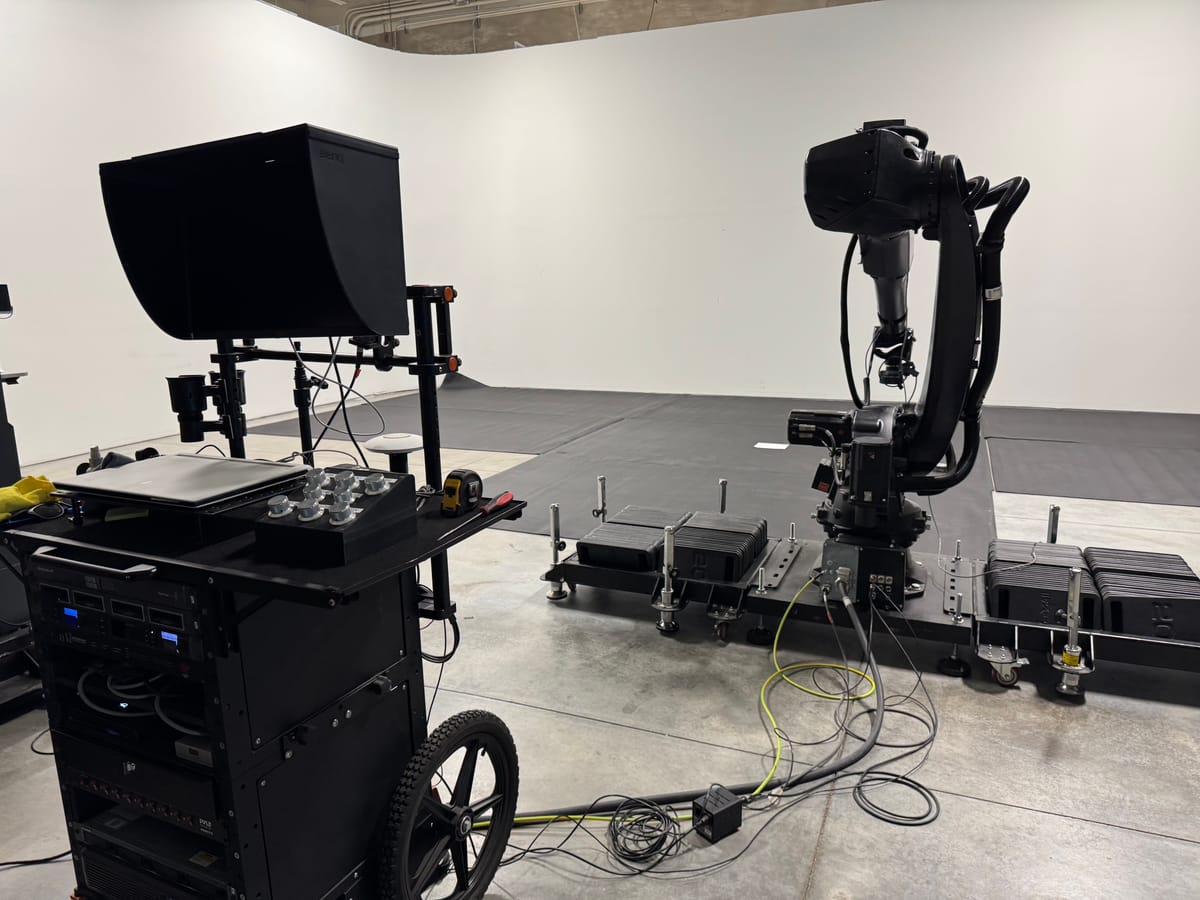
There are two groups that you never want to work with: kids and animals. So let's talk about my experience on a dog food commercial as a motion control operator and cam operator.

There are two groups that you never want to work with: kids and animals. So let's talk about my experience on a dog food commercial as a motion control operator and cam operator.
For context, the shoot was split into two days, with the first day being the capture of animals and action, and the second day to be focused on detail shots of the dog food and ingredients. There would be five different professional stunt dogs of various breeds and sizes, which we would capture similar actions for an hour at a time. I was working with a wonderful director we've worked with countless times before, who essentially was acting as both a director and DP. We captured the dog action on a Phantom VEO 4K, and detail shots on a RED Raptor VV, with the Sigma FF Prime Lenses, splitting between the 35mm, 50mm, and 85mm for a clean, crisp look.
Lesson One: How do predict the unpredictable?
Animals are unpredictable. Even the best, most well trained animals are at most, semi-predictable. Unlike a human actor, you can't really tell a dog to walk in a straight line from A to B and to stop when you hit a certain mark. At best, you can get the dog to stop on the word "stop." So how do you set up that makes everything work for you, the trainers, and the dogs?
The solution we came up with was to block the action in a series of straight lines. The stunt dog would be on one side and the trainer on the other, spread out so that the straight line path the dog would take would intersect perfectly within the depth of field of the camera. Below is a diagram showing what we were attempting to capture.
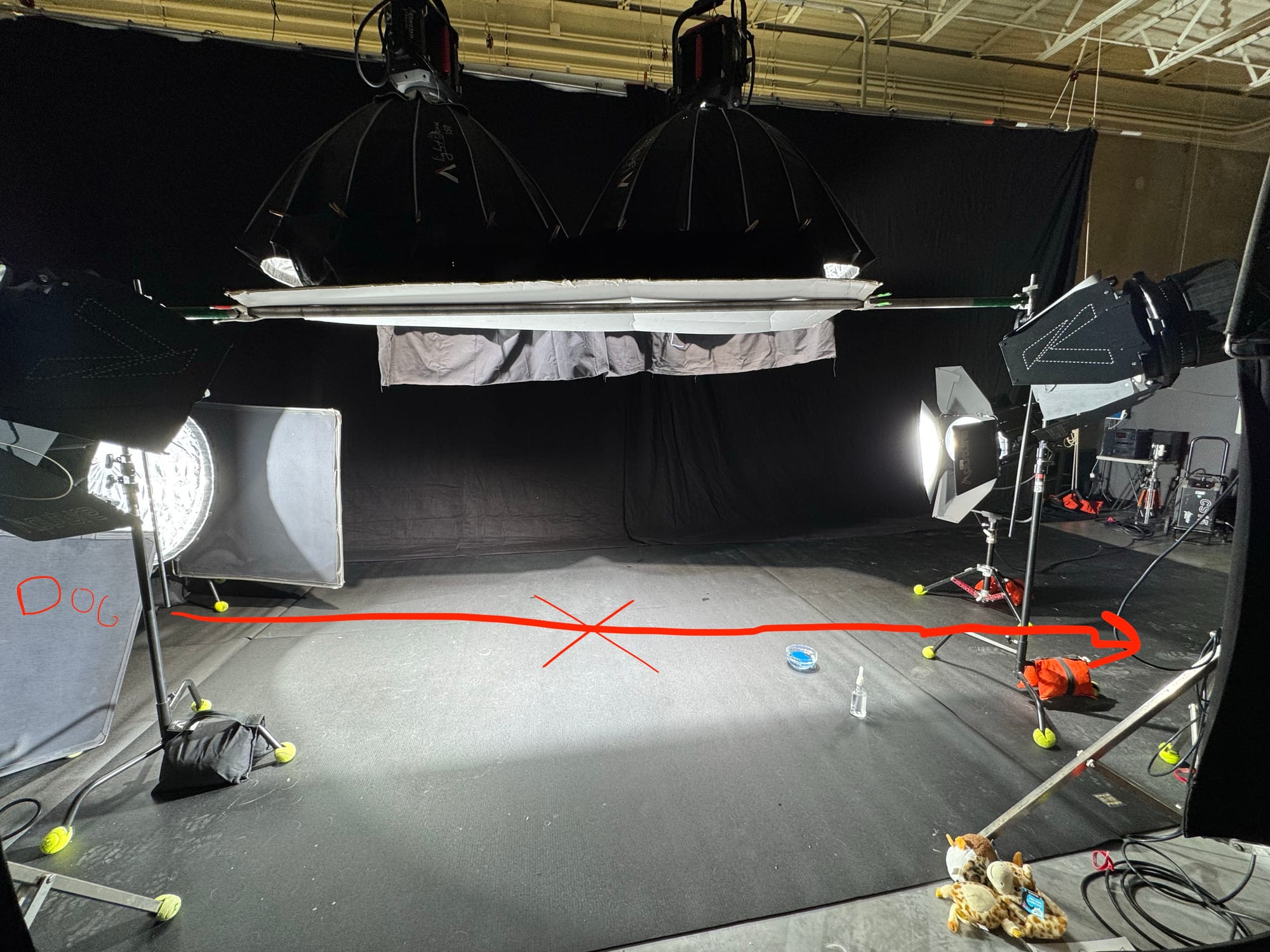
When it came to other action, like jumping or stopping, we set it up the same way. For jumping, we had the trainer stay near the camera, so that the dog would be jumping into focus; for stopping, we had the trainer stay near the camera and shout their command after the dog hit a certain mark.
Overall, it was quite efficient, allowing us to capture about 5-6 actions per a dog.
The main adaptation in thinking here was visualizing where we want the action to occur, and working everything backwards from that critical moment. After all, to get the lifelike, real motion to the action, there needed to be a run up for the dog.
Giving structure to an unpredictable moment, first by defining the critical moment and building up from there, is the biggest lesson of the day.
Lesson Two: Dogs are professionals
One of the coolest moments on set occurred when the trainer called out before one of the dogs got to set.
"These are trained, professional actors here to do a job. Please don't distract them from doing their job."
It's just something that stuck with me as we went on the day. Yes, the dogs are professional actors here to do a job, just like all of us. They needed to focus on their work, which meant that when they got to set, much like real actors, everything needed to be set up and ready for them to focus on their job.
As cute and fun as the footage was, at the end of the day, everyone on set was there to accomplish the same goal , with the same professional focus. Even if we all got distracted by the treats at the crafty table.
Lesson Three: Planning for actors that don't hit their mark
A couple of years ago, I had to film a couple of event captures where a subject was going to get surprised with an award. It was a two camera set up, with one camera focused on the surprisee, and the other on the person handing off the award. And no matter how many times we rehearsed the surprise, no one ever hit their marks, making it always a matter of planning ahead of time how to position myself for success.
When you have an actor that doesn't always hit their mark, or you have actions that don't always have a predictable path, here is what I found works the best.
- Shoot wide enough to punch in without missing the action or losing critical resolution.
- When you shoot wider, you are giving yourself just enough room to capture the action, with the mindset of punching in later. However, if you shoot too wide, you are going to end up losing critical detail on the final deliverable. Know your camera and the end deliverable, so that you know just how wide you can get before punching in results in a downgrade in the footage.
- Go one lens focal length wider than you initially want to capture to get the best depth of field
- When you have unpredictable motion, depth of field becomes critically important. Use a depth of field calculator to understand whether you are better off going with an 85mm further away or a 50mm closer: most times going wider will be the way to go. Even if it is just a couple of inches, having just enough depth of field helps in the long run than missing the action and needing to do another take.
- Position for the critical moments
- Similar to lesson one, positioning is key to success. For some of the dog jumping shots, we had really no idea how high the dog would be and where in frame the dog would end up. Obviously, we tried to position for the apex of the jump in the middle of the frame, just so that anything missed would be slightly higher, or slightly lower. This allowed for us to make slight adjustments after each take that made us work quicker to getting the right take and the best moment.
Final thoughts
While some of these lessons were obvious and lessons learned before, it was a nice refresher to know that the moments on set are going to be reinforced constantly through our careers. The more that we can ingrain them in our everyday practice, the better we will be.
Any lessons you want to share from your time working with animals? Join the conversation below.